
Letting Your Autistic Child Walk to School Alone: How to Handle This Milestone
Updated on September 27, 2026As we head into a new school year, many parents are asking themselves, “Is my child ready to walk to school by themselves this year?”
While this is an important question for every family, for those with school-aged children with special needs, the answer requires a lot of thought. On the one hand, your child is asking for independence. On the other hand, this milestone comes with many follow-up questions, such as: Does your child know what to do if a problem arises? How will they cope with sensory overload on a busy street? Can they manage the route on their own?
It is completely natural to feel caught between wanting to protect your child and wanting to empower them for the new school year. But fostering independence and ensuring safety do not have to be mutually exclusive. You don’t have to choose between walking them to the door every single morning or handing over complete, unassisted independence on day one. By taking a gradual approach throughout late summer and early fall, you can help your child step into the new school year with confidence while keeping a reliable safety net beneath them.
Evaluating Back-to-School Readiness: Is Your Child Prepared to Walk Alone?
There is no universal age or grade level at which an autistic child is automatically ready to walk to school independently. Readiness isn’t about starting 4th grade or hitting a specific birthday; it’s about practical skills, environmental awareness, and how your child handles challenges or disruptions.
Here are a few practical questions you can ask yourself to help decide if walking to school independently is something your child is or will soon be ready for:
- Route Navigation: Can your child reliably identify key landmarks on the way to school, recognize where to turn, and stick to a chosen path?
- Traffic & Crossing Awareness: Do they consistently stop at curbs, watch for turning cars during busy drop-off hours, and understand how crosswalk signals work in real time?
- Handling Morning Surprises: How do they respond if a sidewalk is blocked by construction, a neighbor’s dog barks, or the school’s front entrance is locked when they arrive early?
- Communication Skills: Does your child have a reliable way to communicate if they feel overwhelmed, hurt, or confused? Can they identify a safe adult (like a school crossing guard or morning monitor) to ask for help?
- Sensory Management: Can they navigate busy street noise, bright sunlight, or weather changes without becoming dysregulated to the point where safety awareness drops?
- Safety & Wandering: Is wandering or sudden elopement (bolting away) currently an active concern during transitions?
Keep in mind that your child does not need to master every hypothetical scenario before gaining more independence this school year. Identifying areas where they need extra support simply gives you a roadmap for what to practice together before the first bell rings.
Practice the Route: A Step-by-Step Transition for the New Term
Moving from accompanied walks to complete independence works best as a gradual progression before or during the first few weeks of term. A staggered approach allows your child to build muscle memory and confidence without feeling overwhelmed on day one.
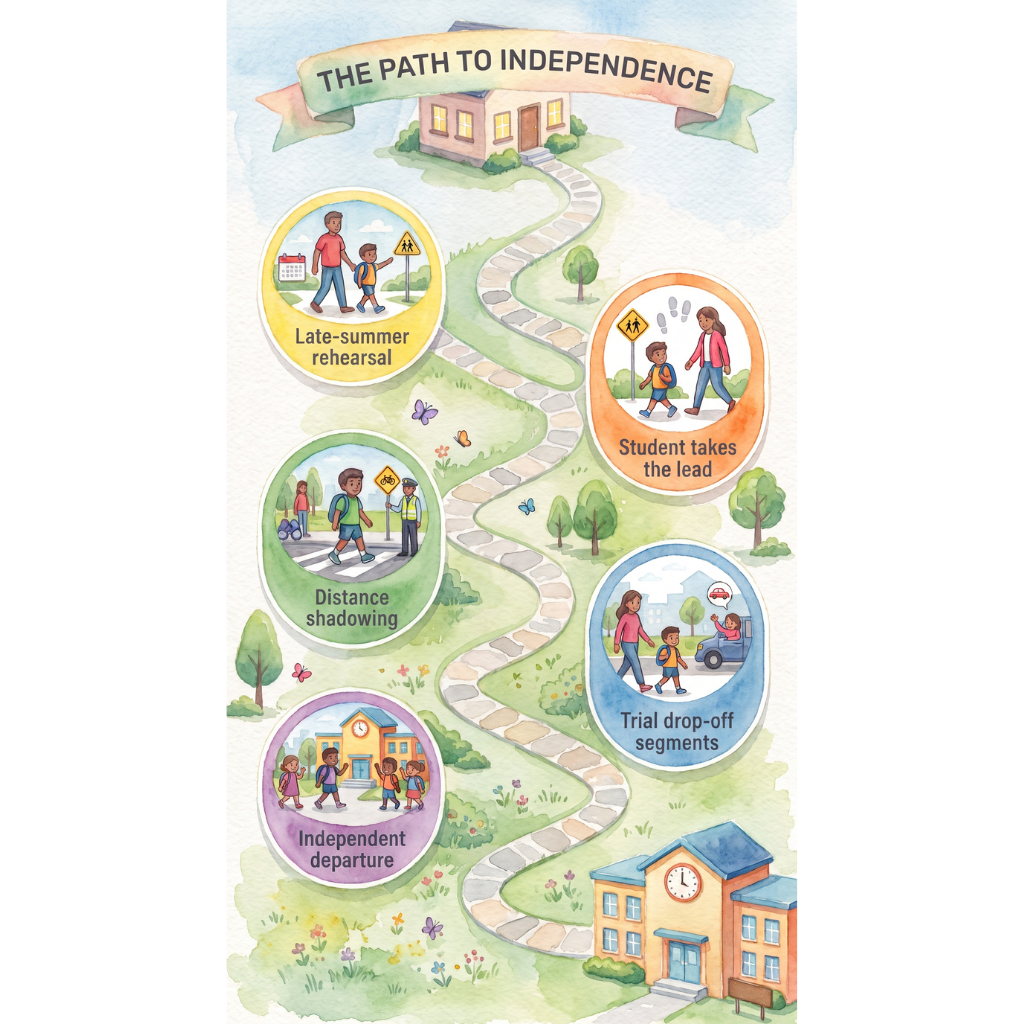
Step 1: Late-Summer Rehearsal
Walk the exact route to school during the actual morning hours your child will be walking. Point out potential hazards, landmark cues (“When we see the yellow house, we get ready to turn”), and crosswalk buttons. Talk through your decision-making out loud while traffic is light.
Step 2: Let Your Child Lead the Walk
During the first week of school, let your child take the lead. Walk beside or slightly behind them, letting them decide when it is safe to cross or which way to turn. Step in only if safety is directly compromised, using quiet pauses to let them self-correct.
Step 3: Shadow From a Distance
Allow your child to walk half a block ahead of you as September progresses. This gives them the authentic feeling of going to school on their own while keeping you close enough to observe how they manage school-zone traffic, driveways, and morning neighborhood distractions.
Step 4: Trial Short Drop-Off Segments
If walking the entire distance feels like too big a leap for the start of the term, start small. You might drop your child off two blocks away from the school gates so they can complete the final leg on their own, gradually expanding the distance as the term moves forward.
Create a Concrete “What If?” Safety Plan
Morning routines can be unpredictable; a missed turn, a construction detour, or unexpected weather can throw off the plan. Preparing your child with clear, visual, or easy-to-remember strategies helps reduce back-to-school anxiety if something goes off-script.
Keep instructions concrete, direct, and focused on actionable steps:
- “What if I miss my turn or feel lost?” Teach your child to stop moving, step to the side of the sidewalk, and use a pre-arranged communication method.
- “What if the sidewalk is closed?” Practice looking for an alternate, safe, paved path rather than stepping straight into street traffic.
- “What if a stranger approaches or offers a ride?” Rehearse a clear, firm response: “No, thank you, I’m walking to school,” and instruct them to keep walking toward the school grounds or a crosswalk guard.
- “What if I feel sensory overload on the walk?” Identify “quiet spots” along the route, like a familiar neighbor’s porch or a quiet bench near the school office, where they can take a short, safe breather.
Consider slipping a small, laminated reference card into their backpack with simple visual reminders and essential emergency contact numbers. Involving your child in creating this plan helps them start the school year feeling empowered rather than anxious.
Coordinate with the School Staff
A smooth back-to-school transition relies on strong communication between home and school. Connecting with staff before or during the first week ensures everyone is aligned on your child’s new routine.
- Establish Arrival Windows: Let the classroom teacher or office staff know approximately what time your child leaves home and when they are expected on campus.
- Define Entrance Procedures: Clarify exactly which door your child should enter and confirm that a morning monitor or greeting staff member will be nearby if support is needed upon arrival.
- Set Up Immediate Arrival Alerts: Confirm how quickly the school contacts parents if a student hasn’t arrived by the morning bell, ensuring swift communication if a delay occurs.
Technology as a Safety Net, Not a Replacement
Technology should never replace teaching road safety, situational awareness, or emergency planning. However, incorporating assistive technology into your back-to-school routine acts as a crucial safety net, giving parents the peace of mind required to step back, while giving students the freedom to step forward into the new year.
This is where assistive technology like AngelSense fits into a back-to-school independence plan. Designed specifically for individuals with autism and special needs, AngelSense provides discreet location and safety monitoring that respects a growing child’s autonomy.
Here’s how AngelSense can support your child’s independent walk to school:
- Live Tracking: Instead of relying on delayed location pings, parents can observe their child’s morning progress in real time, confirming they navigated busy back-to-school crosswalks safely without having to physically tail them.
- Proactive Alerts: Custom boundary and transition alerts notify parents instantly if a child departs from their usual school route, misses a turn, or stops unexpectedly.
- Smart Voice Capabilities: If your child becomes confused or overwhelmed on the way to school, AngelSense features a 2-way voice feature that can automatically answer, allowing you to speak to them, provide reassurance, or guide them safely to the entrance without requiring them to operate a smartphone.
- Sensory-Friendly Wearing Options: For children who experience sensory sensitivities with new school clothes, wearable options, including discrete clips, soft belts, and undershirt attachments, ensure the technology remains comfortable and secure throughout the walk.
Using technology as a safety net means you don’t have to hover or manage every step of the morning. You can let your child experience the pride of walking to school independently, confident that you are alerted immediately if assistance is needed.
Independence Happens in Stages
Building autonomy for the new school year isn’t an all-or-nothing decision. Success doesn’t have to mean walking a full mile alone on the first day of school. For one student, independence might look like navigating the entire neighborhood route solo. For another, it might mean walking the last two blocks from the car to the school gates.
Every step forward, no matter how small, builds self-reliance, confidence, and real-world skills that carry far beyond the classroom. By combining practice walks, clear safety strategies, school collaboration, and assistive technology, you can honor your child’s request for independence and make this school year their most empowering one yet.
Ready to support your child’s journey toward greater independence this school year?
Discover how AngelSense GPS and Assistive Technology can provide the ultimate back-to-school safety net for your family, helping you step back so your child can step forward.
Get peace of mind from AngelSense, the groundbreaking AI-based assistive technology designed to enhance safety and peace of mind for individuals with special needs and their families. Our solution ensures you stay connected with your loved ones, empowering a higher level of independence while maintaining safety. Learn more about how AngelSense can make a difference for your family.
